












Home
›
Nail Health — Science & Care
›
Press-On Nails for Nurses: Short, Safe & Policy-Compliant Designs

Press-On Nails for Nurses: Short, Safe & Policy-Compliant Designs
By Sophie, SHANGMENG Nail Health Writer — references sourced from CDC guidelines, AAD recommendations, and peer-reviewed infection control research.
Quick Answer: Most hospital nail policies follow CDC Hand Hygiene Guidelines, which recommend keeping natural nails short (¼ inch or less past the fingertip) and prohibit artificial nails in direct patient care units. Press-on nails using adhesive tabs — applied at or below fingertip length with no glue, no acrylics, and no nail extensions — can meet many hospital policies while still looking polished. Always verify your specific facility's policy before wearing any nail product.
Healthcare workers face a contradiction other professionals don't: their job requires meticulous hand hygiene, and that same requirement makes conventional nail products — acrylics, gel extensions, long natural nails — a genuine infection risk. For nurses, nursing assistants, medical assistants, surgical technicians, and anyone doing direct patient care, the question isn't "what nail looks best?" It's "what nail is actually allowed, and how do I keep it hygienic across a 12-hour shift?"
This guide cuts through the policy language, explains what the research actually shows about nails and pathogen transmission, and identifies exactly which press-on nail options work within healthcare environments.
Not sure which shape, length, or size fits your natural nails?
Hospital Nail Policies: What CDC Guidelines Actually Say
The foundation of most hospital nail policies in the United States is the CDC Guideline for Hand Hygiene in Health-Care Settings, originally published in 2002 and updated through subsequent guidance. The key language:
- Natural nail length: The CDC recommends keeping natural nails short, defined as tips no longer than ¼ inch (approximately 6mm) beyond the fingertip.
- Artificial nails: The CDC states that healthcare personnel who work directly with patients at high risk (ICU, NICU, surgical units, immunocompromised patients) should not wear artificial nails or extenders.
- Regular nails on non-patient-care staff: Staff who do not perform direct patient care — administrators, dietary workers, some radiology technicians — are typically covered by less stringent policies.
The CDC's reasoning is specific and evidence-based. Research has documented that subungual areas harbor the highest concentration of microorganisms on the hand, including gram-negative bacteria like Pseudomonas aeruginosa and fungi. Longer nails and artificial nail materials can harbor bacteria in ways that routine handwashing doesn't fully eliminate.
A study published in Infection Control & Hospital Epidemiology found that healthcare workers with artificial nails carried more potential pathogens before and after handwashing than those with natural nails. Another study in the American Journal of Infection Control linked artificial nails to NICU outbreaks of Pseudomonas aeruginosa and Klebsiella pneumoniae.
What this means practically: The policy language most hospitals use — prohibiting "artificial nails" — is aimed at acrylic extensions, gel extensions, and nail wraps applied permanently over the natural nail and extending the nail length. These materials can lift and harbor bacteria, and their length defeats the purpose of short-nail policies.
What's Actually Allowed: Reading the Policy Fine Print
The phrase "artificial nails" in hospital policy is not uniformly defined. The practical questions nurses ask are:
Does my hospital ban all nail enhancements, or just extensions?
Many facilities specifically prohibit nail extensions — anything that adds length beyond the natural nail. Nail polish (in some facilities), short gel overlays on natural nails, and certain press-on applications may be in a grey zone. The only definitive answer comes from your specific facility's employee handbook or infection control policy.
Are press-on nails considered "artificial nails"?
This is the critical question. Hospital policies vary:
- Strict interpretation: Some hospitals ban any non-natural nail product in direct patient care areas, including press-ons.
- Length-focused interpretation: Some facilities define artificial nails by their length (tips extending beyond ¼ inch), not by their composition. A press-on worn at or below fingertip length might technically comply.
- Material-focused interpretation: Some policies target specific materials (acrylics, methacrylate compounds) due to documented pathogen risks. Soft gel press-ons using cyanoacrylate tabs are chemically different.
The safest approach: Before wearing any press-on nail to work, consult your unit manager or your hospital's infection control team. Bring the specific product to show the material and application method. Policies should be read literally — not interpreted in your favor.

What Adhesive Tabs Change (and Why They Matter)
Conventional artificial nails are adhered with nail glue — cyanoacrylate adhesive applied to the nail plate, creating a semi-permanent bond that must be soaked or filed off. This creates problems for healthcare environments:
- Removal requires acetone or prolonged soaking — not feasible between patient interactions
- The bond can lift — creating a gap between the press-on and natural nail where bacteria can accumulate
- Glue application leaves residue that can make subsequent handwashing less effective at skin level near the nail
Adhesive tabs — double-sided gel stickers — change this equation:
- No liquid adhesive: No cyanoacrylate contact with the nail plate, no residue
- Controlled lift: A tab that begins to lift can be removed cleanly and completely within 30 seconds — no soaking, no filing
- Gap management: High-quality tabs create a tighter seal than improperly applied nail glue, reducing the micro-gap risk
- Between-shift removal: Many nurses use adhesive tabs specifically because they can remove press-ons before a clinical shift and reapply after — a practice impossible with glued nails
This is why press-on nails without glue using adhesive tabs are the practical choice for healthcare workers exploring compliant nail options. Tabs give you control over when the nail is on and when it's off.

15 Nurse-Friendly Designs
For healthcare workers who can wear press-ons, the design principles are the same as the policy principles: short, clean, inconspicuous. These are designs that meet the spirit of professional healthcare standards.
Natural & Nude Finishes
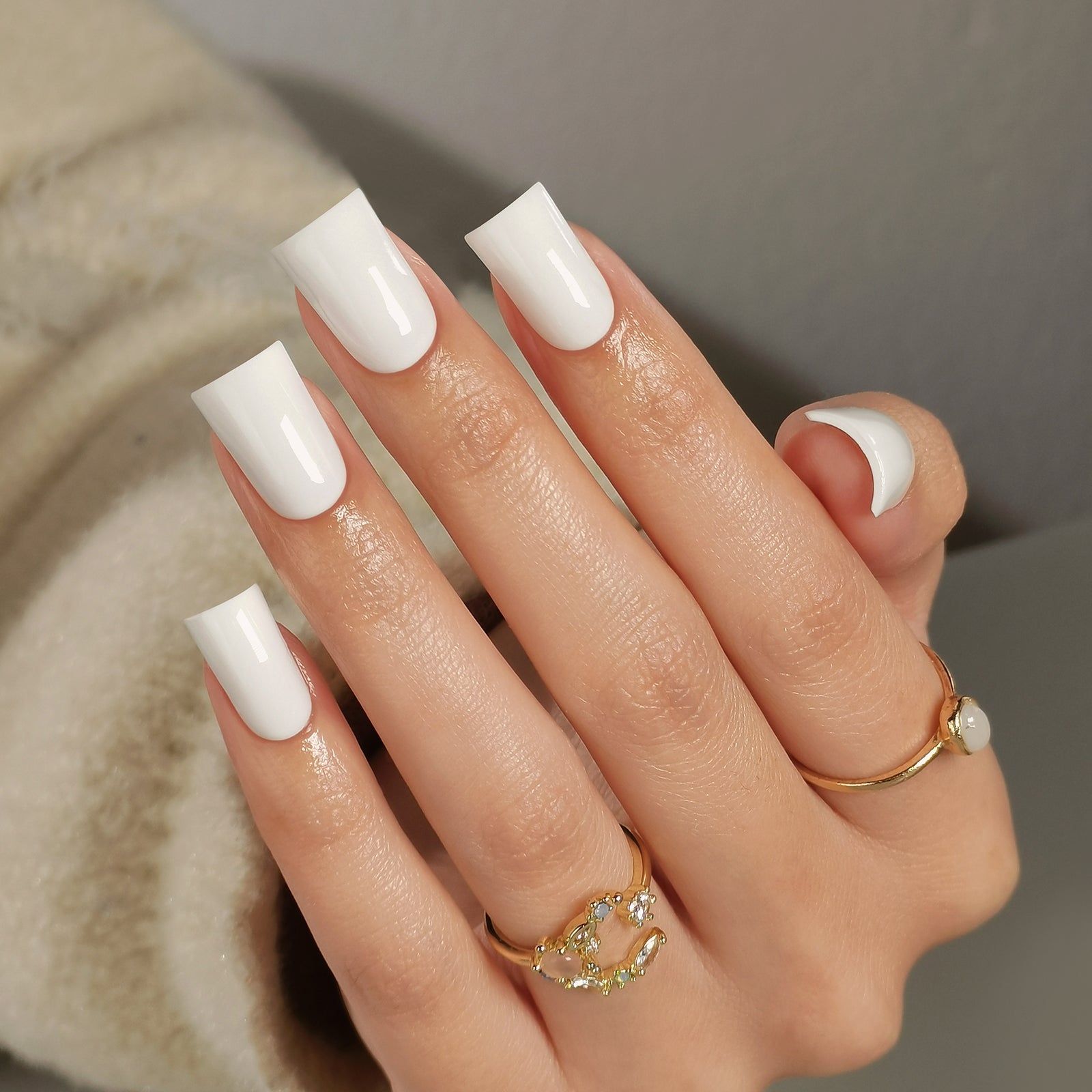
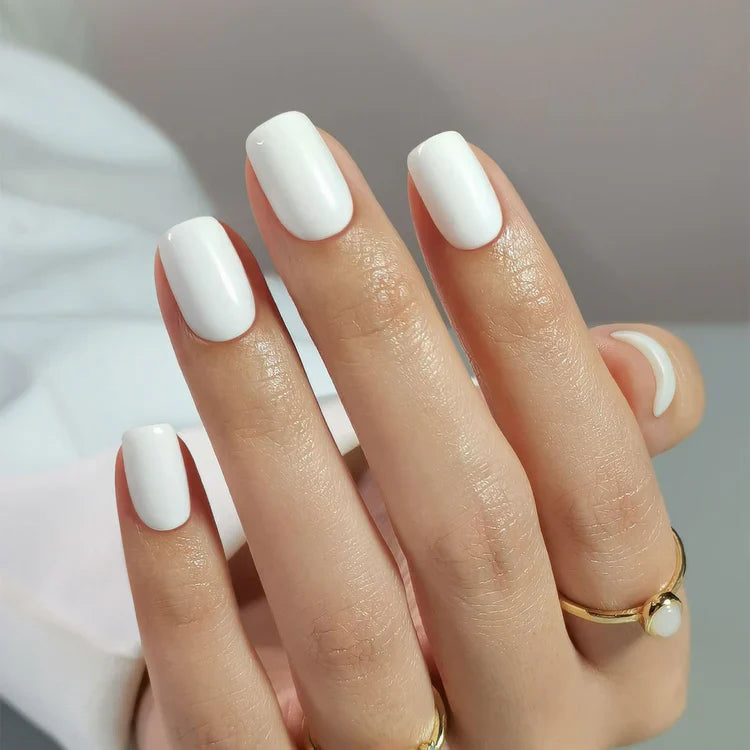
1. Sheer Milky White A translucent white-pink that reads as bare from across the room. Indistinguishable from clean natural nails unless someone is looking closely. Works in any unit.
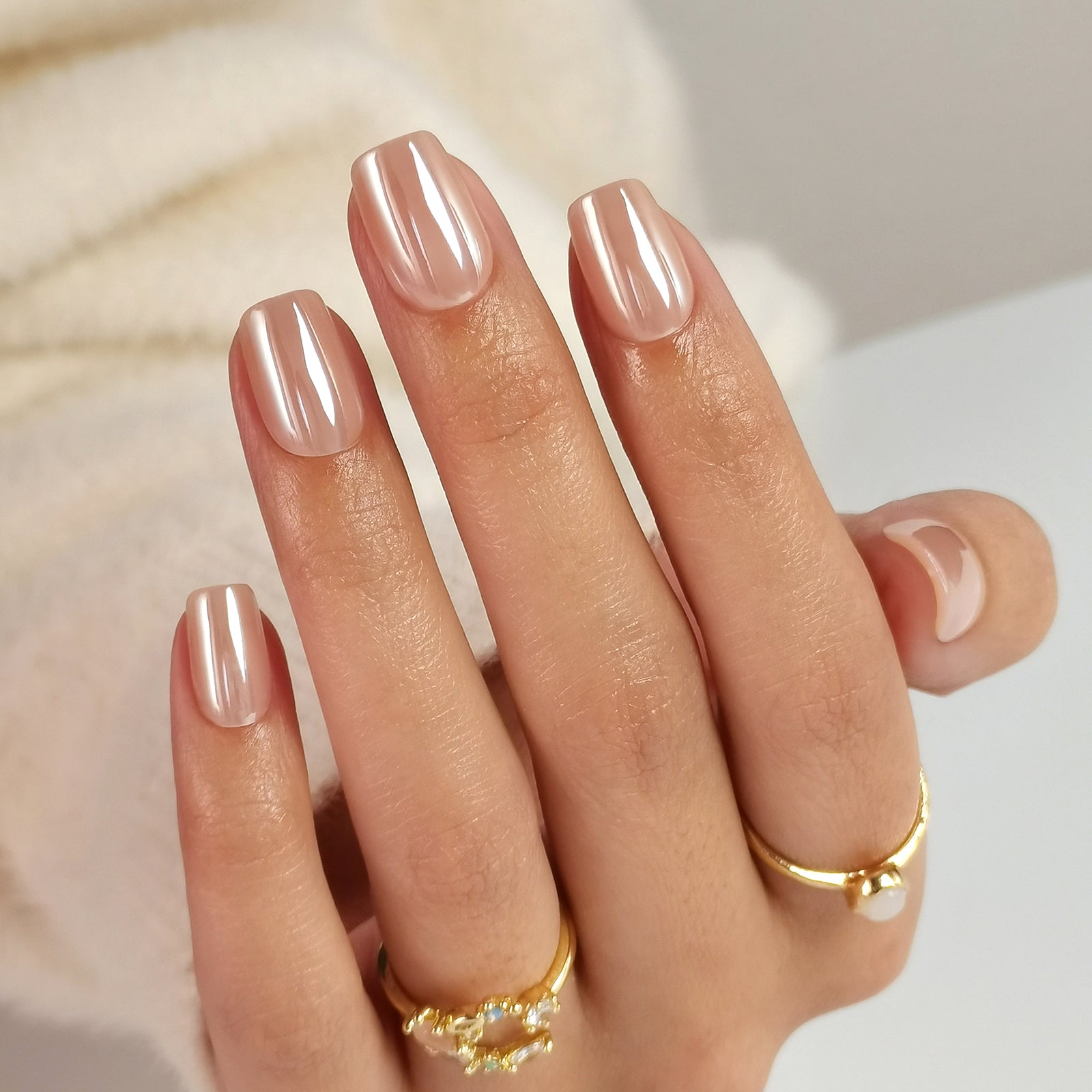
2. Blush Nude A warm beige-pink that matches most skin undertones. The "no nail" nail look for professionals who want polish without presence.
3. Glazed Skin Tone A jelly-finish nude at exact fingertip length. The slight sheen reads as healthy rather than artificial. Extremely low profile.
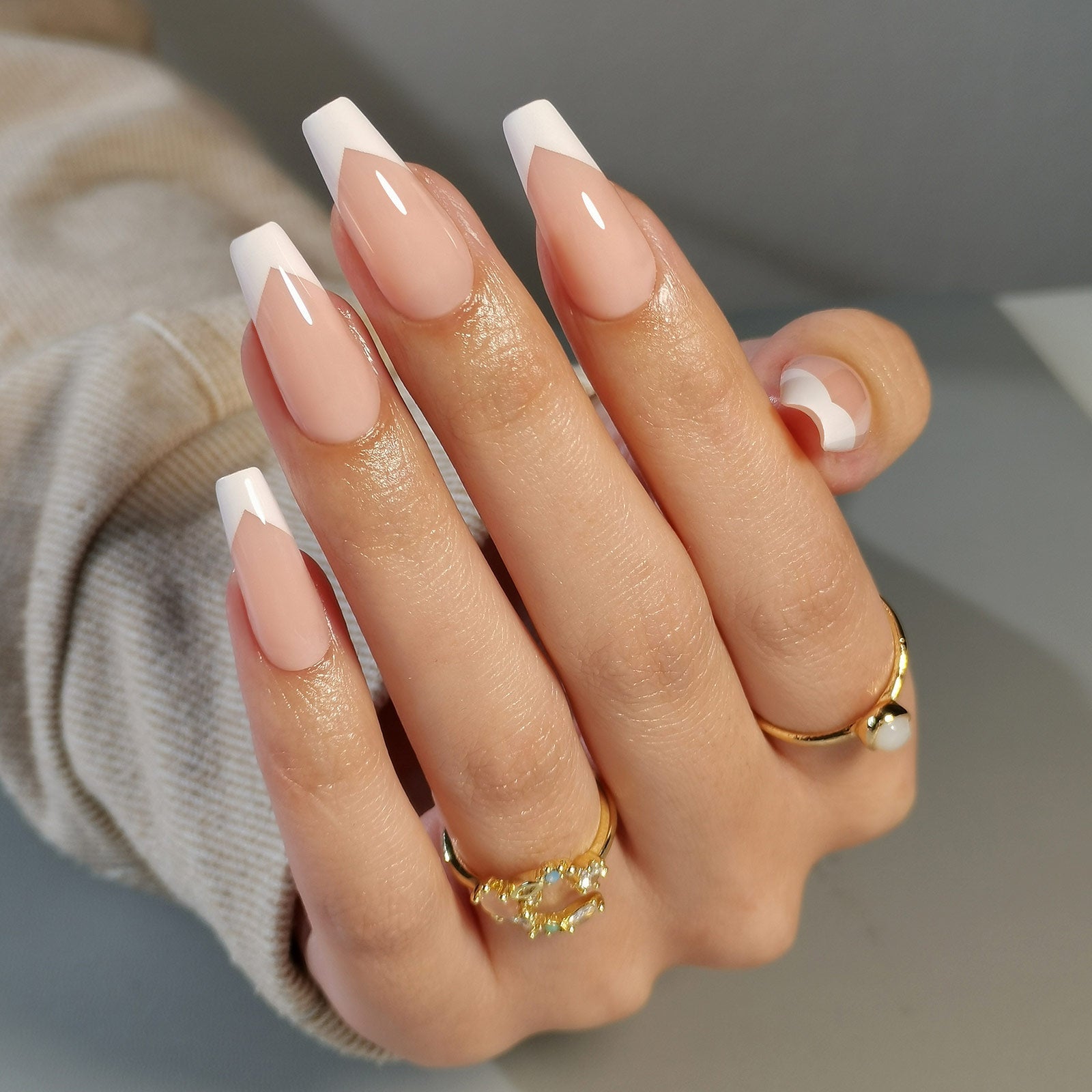
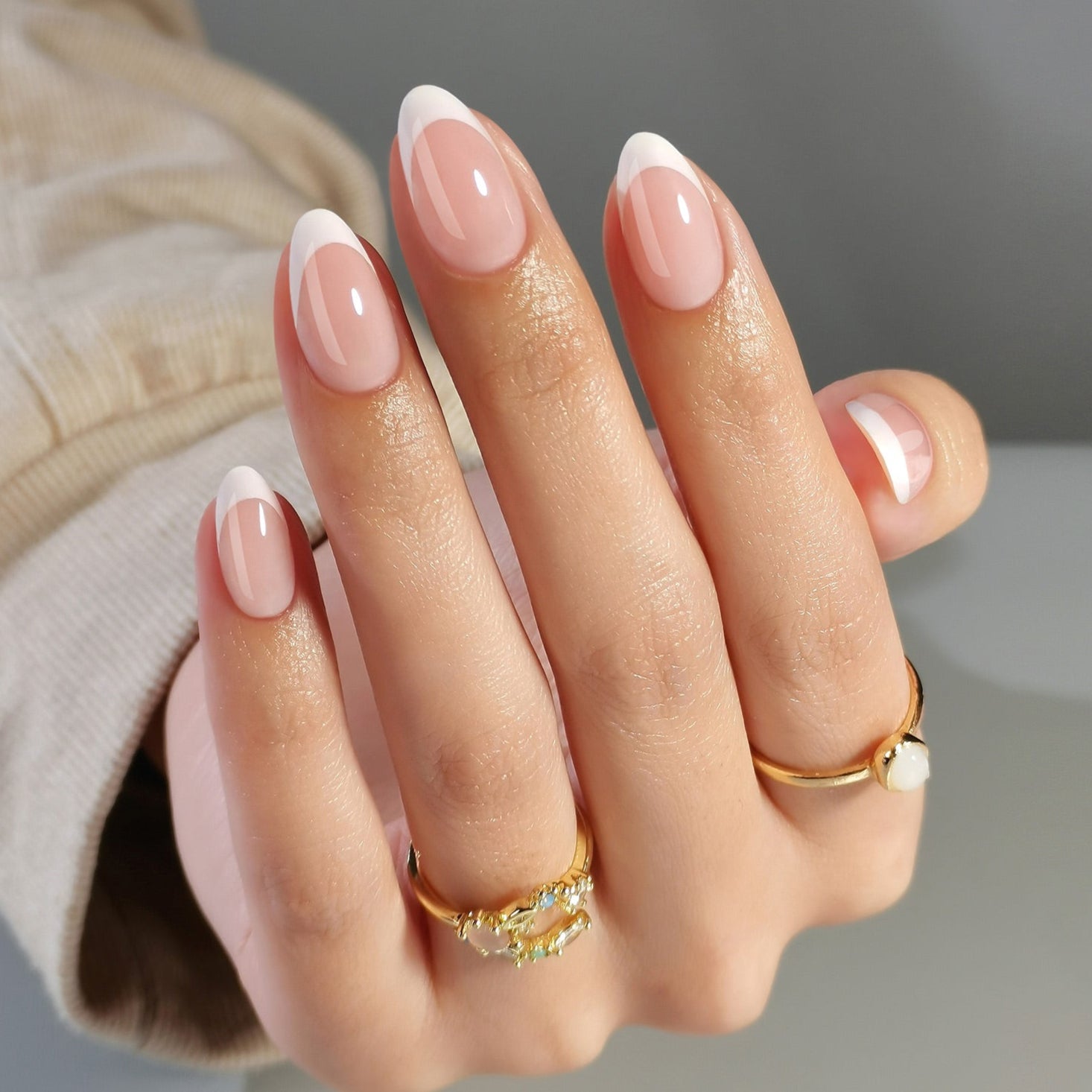
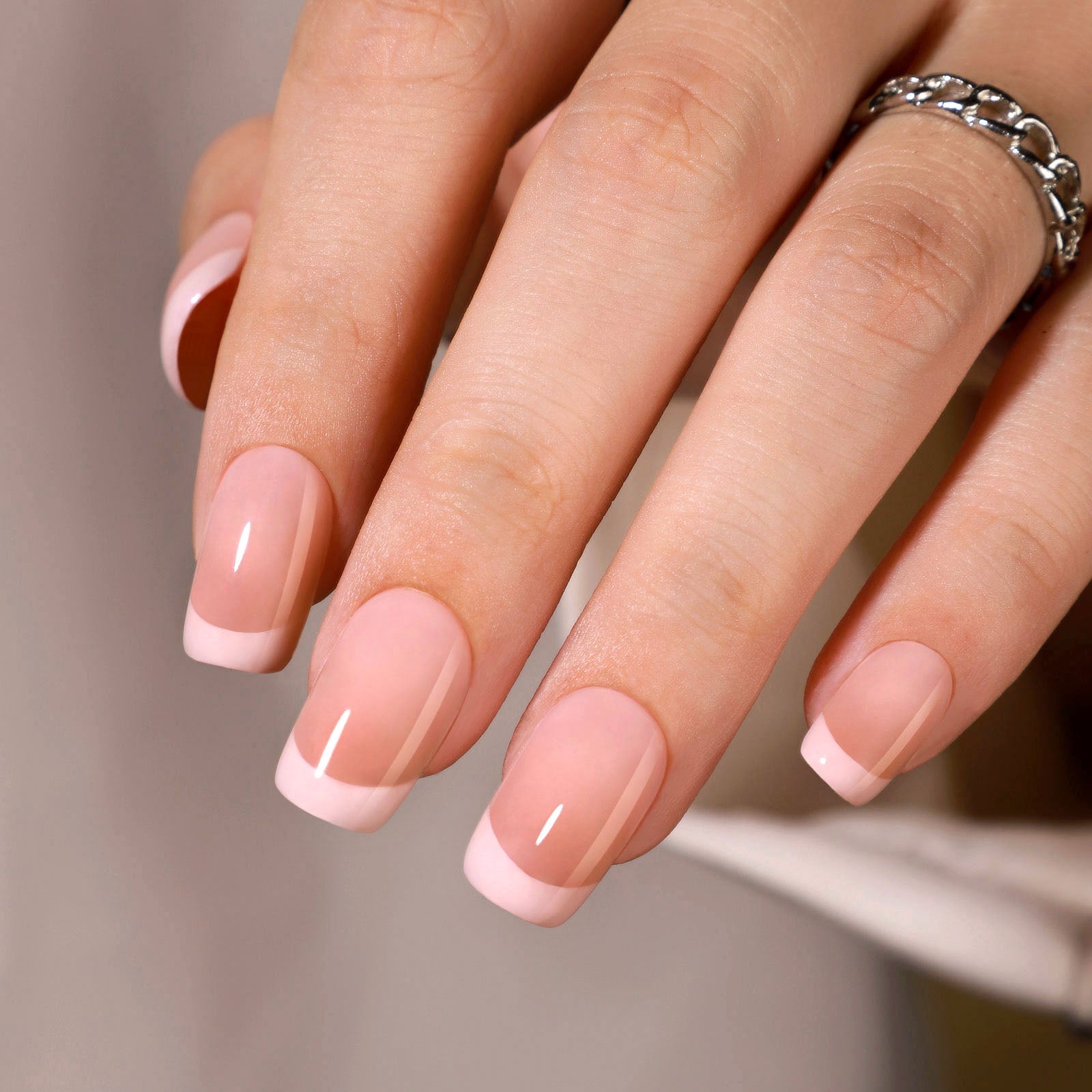
4. Sheer French — Zero Extension Classic white tip on a sheer pink base, with the tip at the natural nail edge, not extending beyond it. The most polished option that still reads as healthcare-appropriate.
5. Pale Rose with Matte Finish Dusty rose in matte — the finish takes away any gel shine that reads as "done up" while keeping color. Matte finishes also show smudges and soiling more easily, which can actually reinforce hand hygiene vigilance.

Low-Profile Color Options
6. Soft Lavender Many hospitals permit color as long as length is within policy. A soft lavender reads as professional rather than clinical; it's the nail equivalent of scrub color variety.
7. Ice Blue A pale blue-grey that looks grey in clinical lighting — neutral but not nude. Works in pediatric or specialty units where color is less out of place.
8. Greige (Grey-Beige) The most universally professional color option. Neither warm nor cool, greige disappears against most skin tones and scrub colors.
9. Dusty Mauve A muted rose-brown that reads as grown-up and appropriate in any clinical setting. Less "nail salon," more "boardroom."
10. Clear with Subtle Shimmer A barely-there shimmer — not glitter, not sparkle — that catches light in a way that reads as healthy nail rather than decorated nail.
Pattern Options (Where Policy Permits)
11. Single Thin Line Detail One thin line of contrasting color along the top edge — modern French equivalent. Extremely minimal.
12. Geometric Microdetail A single small geometric shape on the ring finger accent nail only. Visible on close inspection, invisible at arm's length.
13. Tonal Ombre Same color family, lighter at the base and slightly deeper at the tip. No pattern per se, just tonal variation.
14. Negative Space French The tip area is left sheer while the base is milky — reversed French construction. Modern, minimal, reads as a design choice that doesn't read as "artificial."
15. Solid Terracotta For facilities that allow color broadly, terracotta/brick is a professional autumn-winter option that reads as intentional without being glamorous.
Best Shapes & Lengths for Healthcare

Recommended Shapes
Round: The ideal healthcare shape. No corners to catch on gloves. Rounds at fingertip length don't extend beyond the natural nail and provide maximum glove integrity. See our guide to super-short press-on nails for round options specifically.
Squoval (Square-Oval): Square sides with a slightly rounded tip. Slightly more "done" than round but still extremely practical. Corners are softened enough that glove integrity is maintained.
Square: The most structured option. Works well at fingertip length but corners can occasionally catch on glove edges. Acceptable if length is properly managed.
Short Oval: Similar to round but with slightly more elongation. At fingertip length, this is a polished, professional shape.
Shapes to Avoid
Almond, coffin, stiletto, ballerina: All of these shapes require length to achieve their defining characteristics. At fingertip length, they lose their shape definition and look truncated. More importantly, any version that extends past ¼ inch exceeds policy guidelines.
The ¼ Inch Rule in Practice
¼ inch (6mm) of free edge looks minimal in everyday life. For context:
- A standard US penny is approximately 19mm in diameter
- ¼ inch is roughly the distance from the end of a pencil eraser to the "eraser" stamp
- Most "short" press-on sets marketed as such are still 8–12mm of free edge
For healthcare compliance, look for press-on sets specifically marketed at "fingertip length" or "0–2mm free edge." SHANGMENG's short-length sets are designed for this profile — at or just below the natural nail tip, not above it.
Applying Between Shifts: A Practical Protocol
Many healthcare workers who wear press-ons use a shift-specific protocol: nails off before clinical work, back on after. With adhesive tabs, this is viable.

Before Your Shift (Night Before or 30 Minutes Before Clocking In)
- Remove press-on nails if you wore them during your off hours. Use a tab lifter or wooden cuticle stick — do not pull.
- Wash hands with soap and water, dry completely.
- Inspect natural nails: trim any nail that has grown past ¼ inch. File any rough edges.
- Apply cuticle oil if nails are dry — this is also good pre-shift hand hygiene practice.
After Your Shift
- Wash hands immediately after clocking out — standard post-shift protocol.
- Dry hands thoroughly before applying press-ons — moisture underneath tabs is the primary cause of early lifting.
- Apply tabs to each press-on nail.
- Match press-on size to natural nail — a proper fit is critical for hygiene and durability.
- Apply firm pressure for 30–60 seconds per nail.
Wear Duration with Tabs
Adhesive tabs on short press-ons typically last 1–3 days of regular wear (off-duty hours, not clinical shifts). If you're wearing them only during off hours and removing before work, a single set of tabs can often support multiple remove-reapply cycles if handled carefully.
Storage Between Applications
Keep unused press-ons in their original tray or a clean container. Used press-ons with tabs removed can be re-tabbed 1–2 times before the nail surface becomes too smooth to hold a new tab firmly.
Natural Nail Care for Healthcare Workers
Healthcare workers wash their hands far more frequently than the average person — in some units, 40–60 times per shift. This creates specific nail health challenges:
Frequent handwashing strips natural oils. Apply a cuticle oil or nail-specific moisturizer after your shift ends and before sleeping. The American Academy of Dermatology notes that bacteria and fungi thrive in moist environments, so thorough drying before moisturizing matters. Look for ingredients like jojoba, vitamin E, and sweet almond oil.
Harsh soaps can cause nail plate delamination. The nail plate is made of keratin layers that can separate with prolonged moisture exposure followed by rapid drying. This is called onychoschizia and it's common in healthcare workers. What vitamins are good for nails — biotin and B vitamins specifically — can support keratin synthesis.
Alcohol-based hand rubs are actually less damaging than soap. Studies show that repeated soap-and-water washing causes more nail plate damage than alcohol rub use, because soaps extract lipids from the nail while alcohol rubs contain emollients. Where clinically appropriate, use your unit's alcohol rub in addition to (not instead of) mandated handwashing.
Still worried press-ons will make the problem worse? Find your gentle set after the safety checks above, then remove it without picking.


Gloves cause nail stress. Nitrile and latex gloves create a warm, moist environment that can promote fungal growth in the subungual space. If you experience recurring fungal nail issues, consider keeping nails at the absolute minimum length to reduce the subungual area available for colonization.

Specific Roles and Policy Notes
Intensive Care (ICU/NICU): Most stringent policies. CDC guidelines most strongly apply here. Artificial nails — including most press-on nail products — are generally not permitted. Focus on natural nail health.
Medical-Surgical Units: Policies vary by facility. Some allow color on natural nails; some allow minimal press-ons if length complies. Consult unit policy directly.
Emergency Department: Similar to med-surg in most facilities. Trauma and high-acuity areas often have stricter policies.
Operating Room/Perioperative: Strict no-artificial-nail policies in most facilities. Surgical scrubbing procedures make any nail enhancement a contamination risk.
Outpatient Clinics and Primary Care: Often less strict than inpatient settings. Some allow natural nail polish; press-ons may be acceptable if length complies.
Non-Direct Patient Care Roles (Administration, HIM, Dietary): Typically covered by general professional appearance standards rather than infection control policies. Normal professional nail guidelines apply.
FAQ
What does the CDC say about nurses wearing nail polish?
The CDC's 2002 Hand Hygiene Guidelines state that healthcare personnel should refrain from wearing nail polish if it is chipped, because chipped nail polish harbors more bacteria than freshly applied polish or no polish. The CDC does not explicitly ban nail polish for all healthcare workers — the restriction is specifically on length and artificial nails in high-risk patient care settings. Many facilities have their own policies that go beyond CDC guidelines, so check your facility's specific policy. The American Nurses Association (ANA) recommends following facility policy and common-sense hygiene principles.
Can nurses wear press-on nails in the hospital?
It depends on the facility's specific policy and the unit. The CDC recommends against artificial nails for healthcare workers in direct patient care. Press-on nails that extend the nail length are typically considered artificial nails under these guidelines. Press-ons worn at or below natural nail length using adhesive tabs (no glue) may be interpreted differently by some facilities, but this is not a universal interpretation. The only definitive answer is your facility's official policy, interpreted by your manager or infection control team.
What is the shortest safe length for nurse nails?
The CDC guideline specifies ¼ inch (approximately 6mm) of free edge beyond the fingertip as the recommended maximum. Many infection control nurses recommend going shorter — 0–2mm of free edge — in high-acuity settings. The guiding principle is that nails should not extend enough to compromise glove integrity, harbor bacteria in the subungual space, or interfere with hand hygiene technique. See our short fingernails guide for practical length guidance.
Are adhesive tabs more hygienic than nail glue for healthcare workers?
From a practical hygiene standpoint, adhesive tabs have several advantages: they produce no liquid adhesive residue, they can be removed in 30–60 seconds without acetone, and they allow complete removal before clinical shifts if needed. Nail glue (cyanoacrylate) creates a stronger bond but requires soaking to remove, which is impractical in clinical settings. Neither adhesive is sterile. The primary hygiene consideration for healthcare workers is nail length, not adhesive type.
Do hospital hand hygiene audits check nails?
Most formal hand hygiene audits focus on technique (duration, coverage, soap-to-rub ratio) rather than nail appearance. However, infection control teams conduct periodic dress code and appearance audits separately. Some facilities include nail checks as part of annual competency or onboarding. Being flagged for nail length or artificial nail policy violations is a real risk, particularly in accredited facilities where Joint Commission surveyors may review infection control practices.
What are the best nail shapes for nurses who wear gloves all day?
Round and squoval shapes are best for glove wear. Square corners can catch on glove edges during donning and create micro-tears in gloves, which compromises barrier protection. Round tips at fingertip length slide into gloves cleanly and create the least stress on both the glove material and the nail. Natural-looking press-on nail options in round and squoval at fingertip length cover most healthcare appearance standards.
Choosing the Right Set

If you've confirmed your facility allows press-on nails (or you're shopping for off-duty wear), prioritize:
Length: Look specifically for sets labeled "short," "fingertip length," or "0–2mm free edge." Avoid any set described as "medium," "long," or that shows nail tips extending visibly beyond the finger in product photos.
Shape: Round or squoval for glove compatibility. Avoid almond, coffin, and stiletto at any length.
Finish: Sheer, nude, or minimal color for on-duty use where policy allows; full design range for off-duty wear.
Application: Adhesive tabs over glue if you need removal flexibility. Our complete guide to adhesive tab press-ons covers sizing, application, and how to extend wear time.
SHANGMENG's 32-piece sets include 16 sizes — critical for healthcare workers because a well-fitted nail won't lift at the edges the way an ill-fitting nail can. Edge lifting is both an appearance issue and a hygiene issue (it creates a gap for bacteria). Proper sizing eliminates the gap entirely.
Nurses who want a dedicated short set that reads as natural as possible while staying polished can also explore our super-short round and squoval options — specifically designed for the practical length that healthcare environments require.
Every set ships with 32 pieces in 16 sizes for a precise, hygienic fit.

Sources: CDC Guideline for Hand Hygiene in Health-Care Settings (2002, updated 2019). American Academy of Dermatology nail care guidelines. Infection Control & Hospital Epidemiology (Foca et al., 2000): artificial nail link to NICU Pseudomonas outbreak. American Journal of Infection Control: subungual microbial colonization studies. American Nurses Association professional appearance guidelines.
Share