












Home
›
Guides — Press-On Nails Tutorials
›
Different Shapes of Nails Explained: Visual Guide to All 10 Types

Different Shapes of Nails Explained: Visual Guide to All 10 Types
The different shapes of nails are distinguished mainly by tip geometry — square, round, oval, squoval, almond, coffin, stiletto, duck, lipstick, and mountain peak each affect durability, finger proportion, and lifestyle fit.
Written by Paul, SHANGMENG Nail Care Specialist
Nail shape is the single most consequential decision in a manicure. Color gets noticed, but shape determines how your fingers look from across a table, how long a set lasts before it snags, and whether the nails feel comfortable after day two or day fourteen.
The problem is that most guides list shapes by name without actually explaining what differentiates them — why coffin and stiletto look similar but wear differently, why squoval exists as a distinct category instead of just a rounded square, or what makes duck nails useful instead of merely unusual. This guide fixes that.
Below are all 10 major nail shapes currently available in press-on nail sets, each with a precise visual description, the mechanical reason for its pros and cons, and clear guidance on who should actually wear it.
Not sure which shape, length, or size fits your natural nails?
Why Shape Matters More Than Color
Color choice is reversible in seconds. Shape choice is not — at least not in a traditional salon context.
The American Academy of Dermatology recommends keeping nails clean, dry, shaped, and free of snags in its healthy nail tips, and its nail-trimming guidance specifically notes that lightly rounding corners helps strength and reduces catching. The FDA's nail care products overview is also a useful safety baseline when comparing acrylic, gel, and press-on formats. That guidance reveals something important: the natural curve of your fingertip is not a square, a stiletto, or a coffin. Every nail shape is a departure from that baseline, and each departure has mechanical consequences.
Structural durability differs across shapes because stress concentrates at corners and tips. Pointed tips (stiletto, mountain peak) concentrate all lateral stress at one narrow point — beautiful, but fragile. Squared corners (square, coffin) distribute stress laterally but snag on fabric. Rounded profiles (round, oval) distribute stress most evenly across the tip arc.
Visual proportions change the perceived length and width of your fingers. Long oval and almond shapes create the illusion of elongated fingers. Wide shapes (squoval, duck) make fingers appear broader. Pointed shapes draw the eye upward and create the perception of length.
Lifestyle compatibility determines whether a shape survives past day three. Shapes with exposed corners or dramatic points require more deliberate hand movements. Rounded and squoval shapes handle daily tasks with the least adaptation.
Press-on nails change this calculation significantly. Because a press-on set is pre-shaped at the factory, switching from square to almond requires no filing skill — just a different set. That is a meaningful advantage over salon acrylics, where shape changes require time and cost.
The 10 Nail Shapes Explained
1. Square

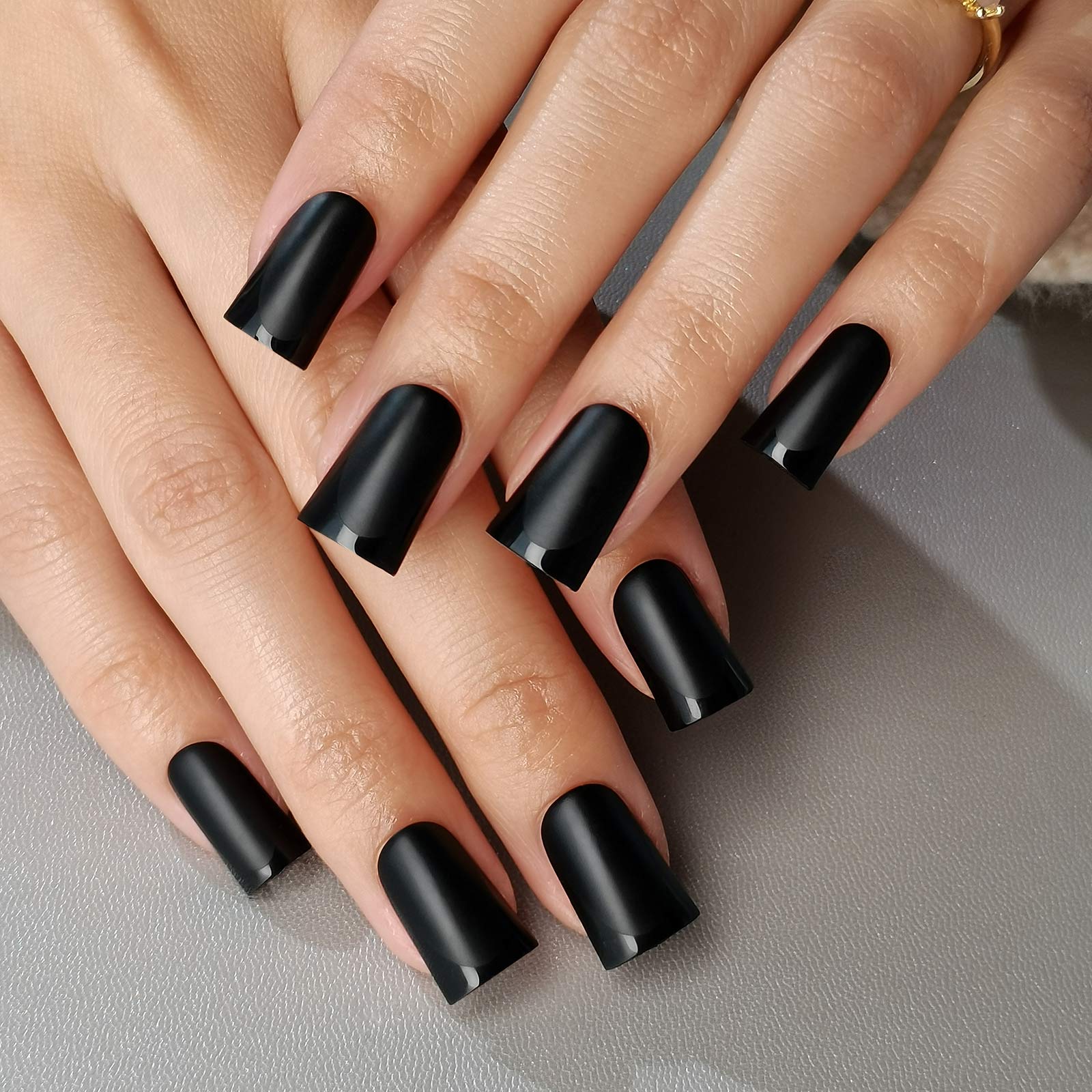
Visual description: The free edge is filed perfectly flat and horizontal, creating a 90-degree angle where the side walls meet the tip. The nail has no taper — the same width at the base is maintained all the way to the top.
Pros: Maximum surface area for nail art and designs. Architectural, modern aesthetic that reads well in professional settings. The flat tip is one of the most durable geometries in terms of direct downward impact.
Cons: The sharp corners are the primary failure point. They catch on fabric, hair, and edges with regularity. They also require wider natural nail beds to avoid looking like the nail is fighting the finger.
Best for: Wide or square nail beds, fans of graphic nail art, people who prefer a structured look. Full square nail guide in our dedicated article.
2. Round
Visual description: The free edge follows the same curve as the natural tip of the finger — a gentle arc that mirrors the shape of the fingertip when viewed from directly above. No flat section at the top; the sides taper smoothly into the curve.
Pros: The most forgiving shape for daily tasks. No corners to snag, no points to break. Round nails look clean at shorter lengths where other shapes start to look stubby. The symmetrical arc suits nearly every hand shape.
Cons: Round shapes can look less dynamic at longer lengths. Because the silhouette is familiar and soft, it can read as generic if not paired with a statement color or finish.
Best for: Short to medium lengths, active lifestyles, people new to nail extensions, natural-looking manicures.
3. Oval
Visual description: Like round, but with a more elongated arc. The sides of the nail taper inward as they extend toward the tip, creating a narrower free edge than the nail base. The result is egg-shaped when viewed head-on.
Pros: Creates the strongest illusion of elongated, slender fingers of any non-pointed shape. Oval is more elegant than round at medium-long lengths while maintaining a softer profile than almond. Fewer snagging incidents than square or coffin.
Cons: Requires some length to work — at very short lengths, oval and round are nearly indistinguishable. The tapered sides mean the nail is structurally narrower at the tip, which can feel vulnerable if you frequently use fingertips as tools.
Best for: Short, wide, or chubby fingers where elongation is a priority. Everyday professional wear. See the full oval-vs-round comparison here.
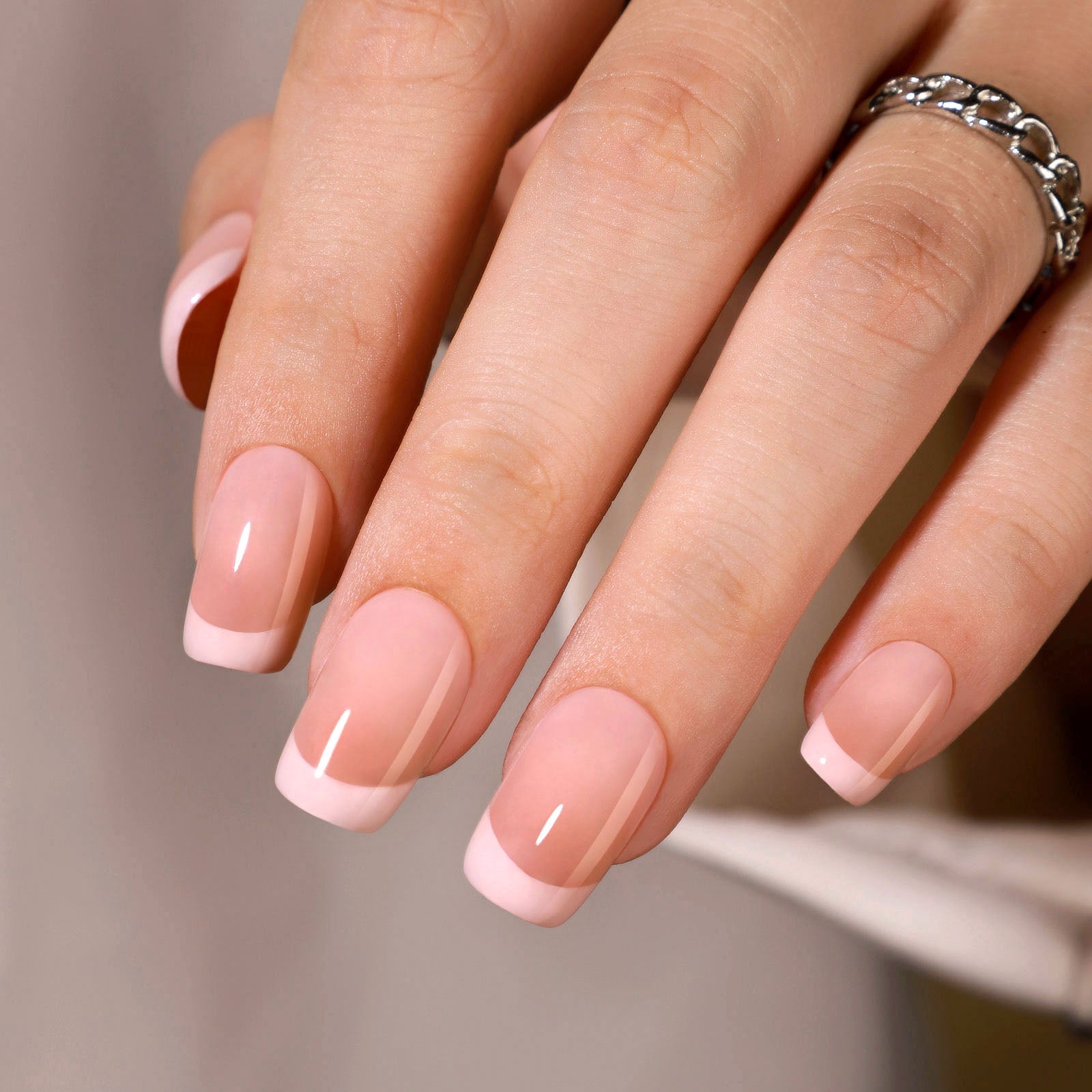
4. Squoval

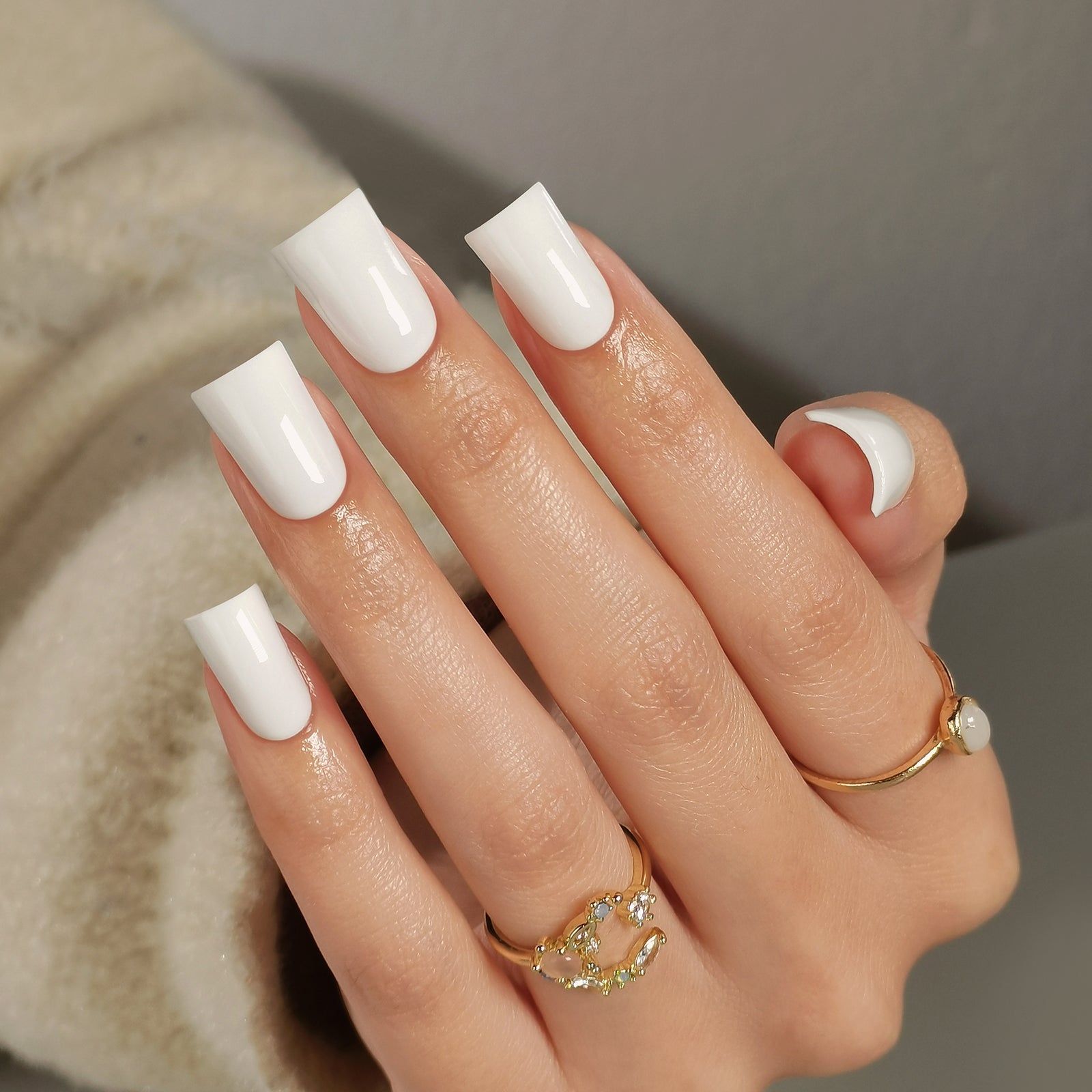
Visual description: Square tip geometry — flat across the top — but with the corners filed into a slight curve rather than left at 90 degrees. The result from above looks like a square with its corners sanded off.
Pros: Squoval is the most practical shape for people who want the clean modern look of square without the corner-snagging problem. It retains the flat tip's visual boldness while reducing the most common failure mode of square nails.
Cons: Can look slightly undefined compared to a crisp square. The design is a deliberate compromise, and some wearers find the "almost square" aesthetic less satisfying than committing to one direction.
Best for: Practical wearers who admire square aesthetics. First-time press-on users. Full squoval guide here.
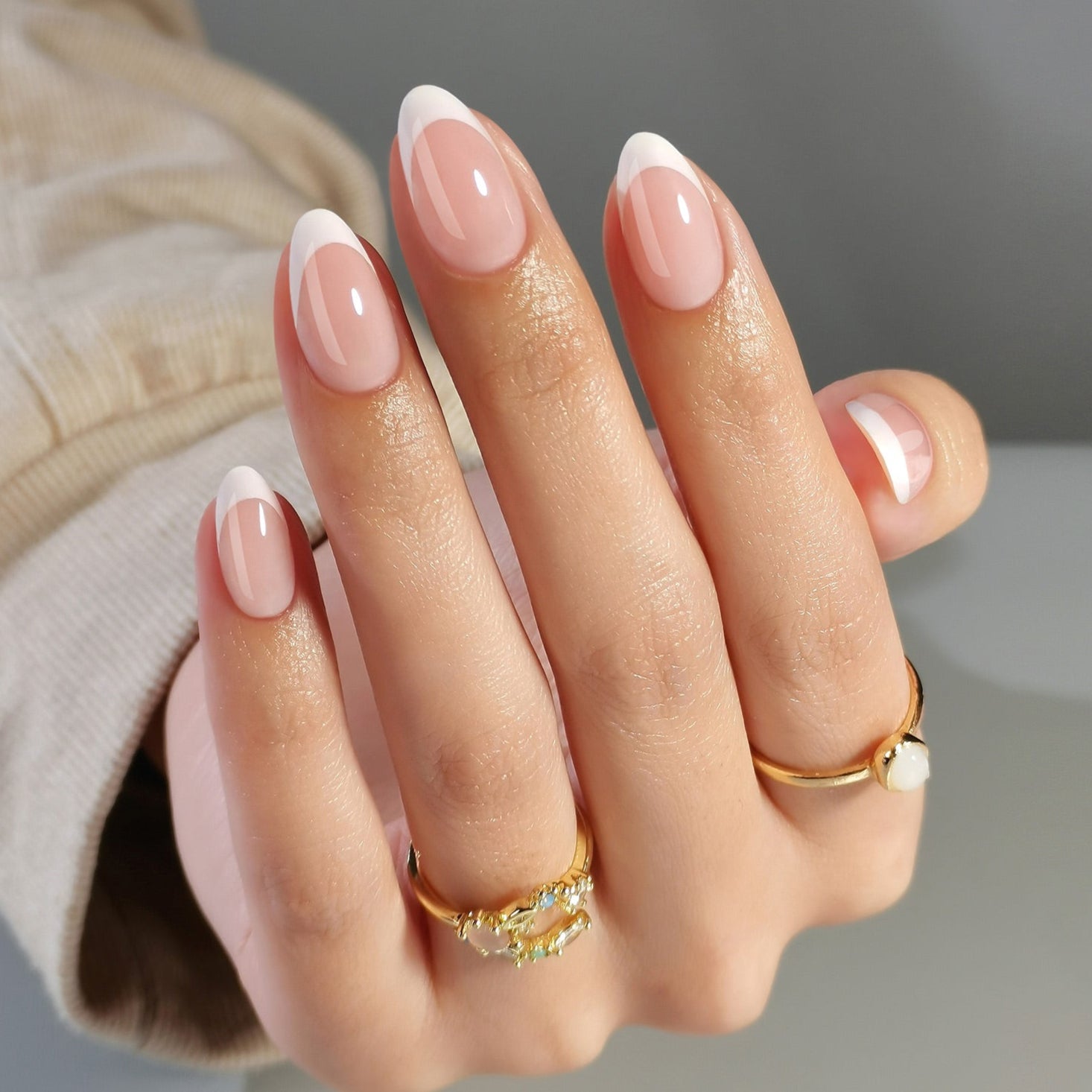
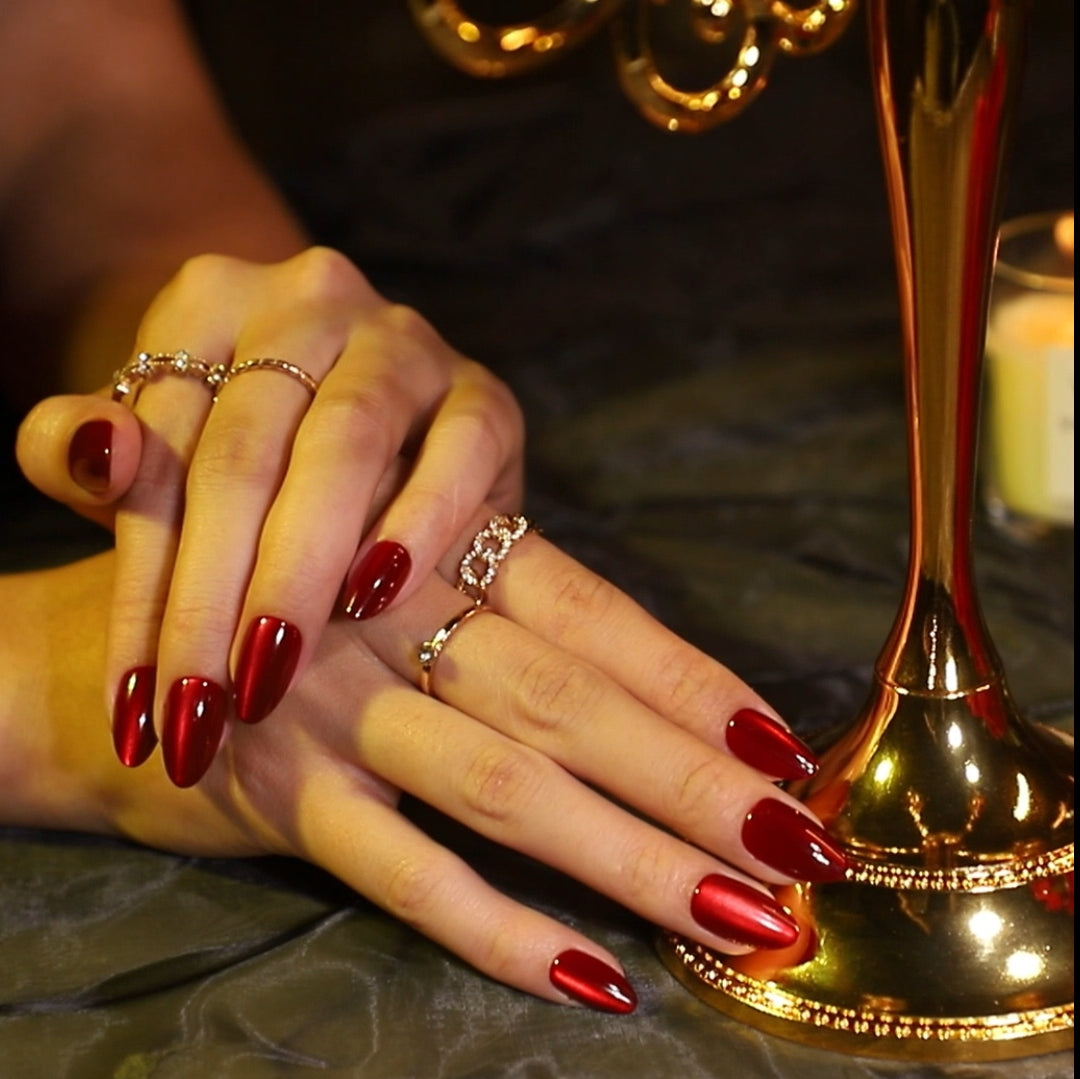
5. Almond
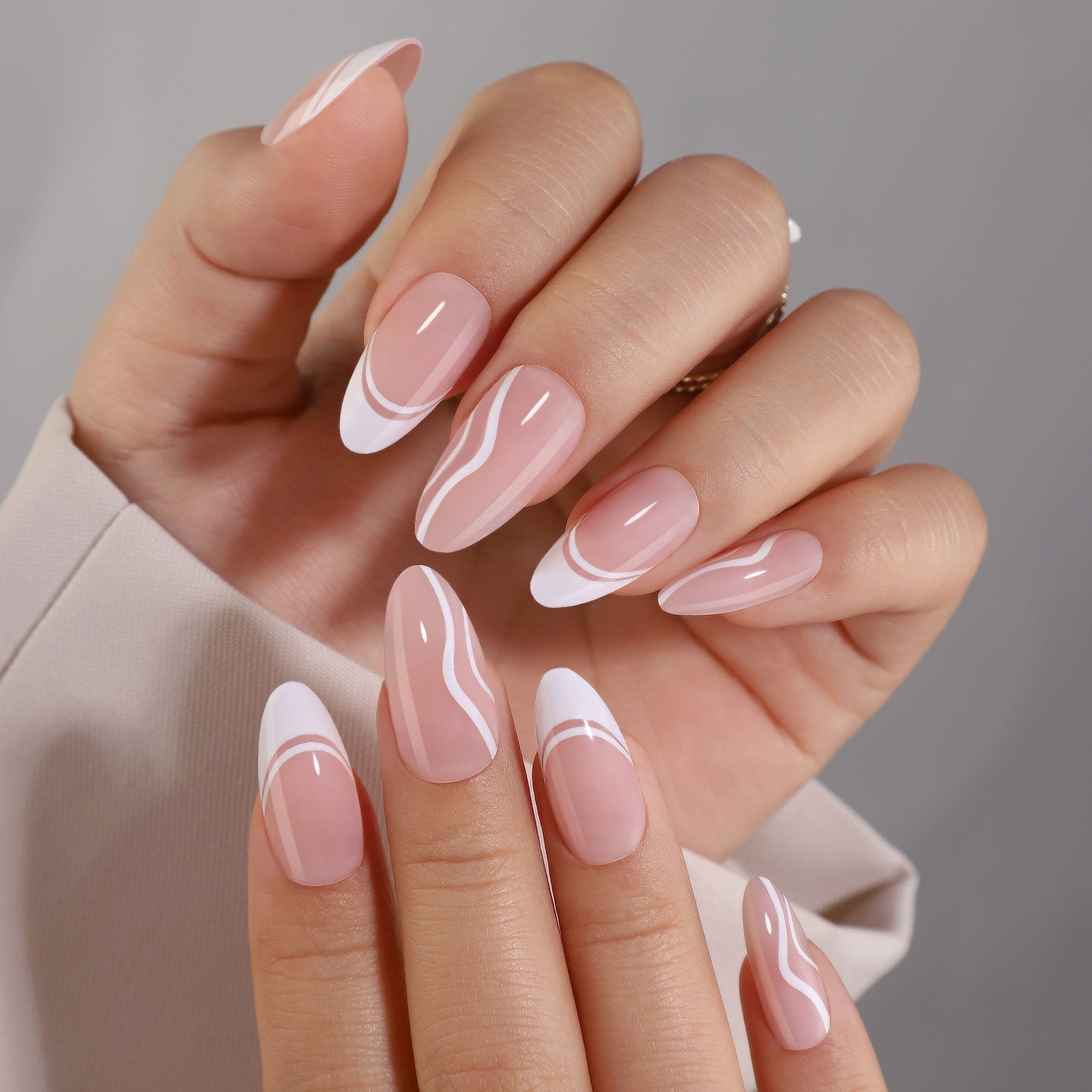
Visual description: Wide at the base, narrowing steadily on both sides to meet at a rounded point at the tip — the same silhouette as a peeled almond kernel. The sides taper visibly, and the tip is round, not sharp.
Pros: The most universally flattering shape for feminine aesthetics. Almond elongates fingers without the structural fragility of stiletto. The rounded tip avoids the snagging problems of square while the tapered sides create a sleek profile.
Cons: Requires length — almond at short lengths looks pinched rather than elegant. The narrow tip area is more prone to breakage than round or oval at equivalent lengths.
Best for: Medium to long lengths, feminine aesthetics, fingers of any width (almond flatters both narrow and wide nail beds). Full almond shape guide here.
6. Coffin (Ballerina)

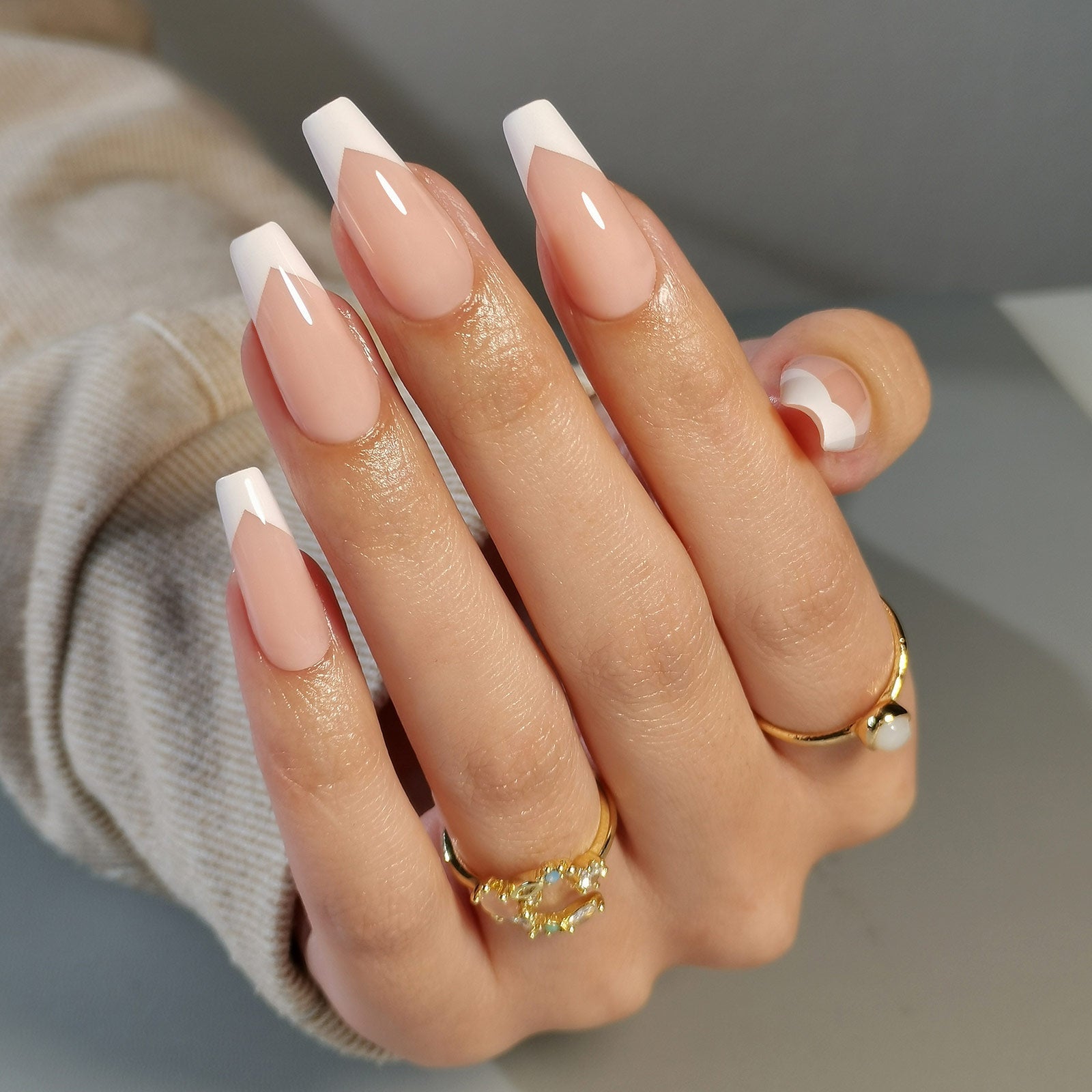
Visual description: The sides taper toward the tip like an almond, but instead of rounding to a point, the tip is filed flat and horizontal. The result is a long, tapered nail that ends in a squared-off platform — resembling a coffin or a ballerina's pointe shoe (hence both names).
Pros: Coffin combines the elongating effect of tapered sides with the flat-tip surface area needed for complex nail art. It is the dominant shape in professional nail competitions and editorial nail photography for this reason. The shape looks particularly dramatic at longer lengths.
Cons: The flat tip at the end of a taper creates a structural stress point — the narrow tapered walls meet a horizontal tip that takes all frontal impact. Coffin nails break more readily than square nails of equivalent length. They also require genuine length to achieve the characteristic silhouette.
Best for: Longer lengths, nail art enthusiasts, dramatic aesthetics. People who frequently use their hands in precision tasks may want a more durable alternative.
7. Stiletto
Visual description: Like almond but taken to its extreme conclusion. The sides taper aggressively from a wide base to a sharp, fine point at the tip. There is no rounding at the terminus — the two side walls meet at a true point.
Pros: The most architecturally dramatic nail shape. Stiletto is the only shape that creates a true claw silhouette, and at longer lengths it is genuinely architectural in scale. It photographs extremely well.
Cons: The pointed tip is the weakest structural point in any nail geometry. All lateral stress concentrates at one microscopic contact area. Stiletto nails break more frequently than any other shape and require the most behavioral adaptation (typing, opening cans, and handling small objects all require modification).
Best for: Fashion photography, special events, creative expression. Not recommended as a daily-wear shape for people who work with their hands.
Still worried they will look fake? Find your shape and finish by matching your natural nail width; the right set reads polished, not pasted on.


8. Duck (Flare)

Visual description: The reverse of most tapered shapes. Duck nails are narrow at the base and flare outward toward the tip, ending in a wide, flat edge that is significantly broader than the nail base. Viewed from above, the nail resembles a duck's foot (hence the name) or a fan.
Pros: Duck nails create maximum surface area at the tip — more space for nail art than any other shape. The wide tip is visually bold and distinctive. Many wearers find the broad tip easier for certain tasks (typing, as an example, where the flat wide surface distributes keystroke impact).
Cons: Duck nails are not universally accepted in professional or formal environments. The dramatic flare can look disproportionate on narrow nail beds. Because the shape widens at the tip, they catch on surfaces in a different way than pointed or squared shapes.
Best for: Creative and expressive aesthetics, nail art with maximum canvas space, wearers comfortable with a bold and unconventional silhouette. Full duck nail guide here.
9. Lipstick
Visual description: A shape inspired by the angled top of a lipstick tube. The tip is filed diagonally — one side higher than the other — creating an asymmetrical slant across the free edge. Viewed straight on, the nail has a parallelogram-like quality at the tip.
Pros: Lipstick nails are genuinely unusual. The diagonal tip creates a graphic, architectural quality that draws attention precisely because it is unexpected. The asymmetry adds dynamism to even simple single-color designs.
Cons: The asymmetrical tip means one corner is the highest point of the nail — this corner is the structural stress point for both snagging and impact. Lipstick nails require more careful application to ensure the diagonal reads correctly across all nails without looking misapplied. Press-on sets in this shape are less commonly available than the primary seven shapes.
Best for: Fashion-forward wearers, nail art creatives, people who wear their nails as a genuine style statement.
10. Mountain Peak (Arrowhead)

Visual description: A broader, more angular version of stiletto. Where stiletto achieves its point through a steady narrow taper, mountain peak creates a pointed tip through a more abrupt angle — the sides meet at the tip at a wider angle, creating a triangular profile rather than a needle-like one.
Pros: Mountain peak achieves a pointed, dramatic effect with slightly more structural mass than stiletto. The wider angle at the tip means slightly more material contact before the stress point.
Cons: Still a pointed tip — and pointed tips break. Mountain peak shares most of stiletto's practical limitations. It also requires precision application to ensure the pointed tip remains centered on each nail.
Best for: The same wearers drawn to stiletto who want a slightly more robust interpretation. Event nails, creative expression.
Ready to try a new shape? SHANGMENG press-on sets come pre-formed in the shape you choose — no filing, no salon appointment. Each set: 32 pieces, 16 sizes, $10–14. Shop press-on nail shapes →
Nail Shape Comparison Table
| Shape | Tip Style | Durability | Elongating Effect | Best Length | Lifestyle Fit |
|---|---|---|---|---|---|
| Square | Flat, 90° corners | High (tip) / Low (corners) | None | Short–Medium | Professional |
| Round | Curved arc | High | Moderate | Short–Medium | Active, everyday |
| Oval | Tapered arc | Moderate–High | High | Medium–Long | Professional, everyday |
| Squoval | Flat + soft corners | High | Low–Moderate | Short–Medium | Practical |
| Almond | Tapered, rounded point | Moderate | High | Medium–Long | Feminine, everyday |
| Coffin | Tapered, flat top | Low–Moderate | High | Long | Fashion, nail art |
| Stiletto | Tapered, sharp point | Low | Very High | Long | Events, fashion |
| Duck | Flared wide | Moderate | None | Medium–Long | Creative |
| Lipstick | Diagonal slant | Low–Moderate | Moderate | Medium–Long | Fashion-forward |
| Mountain Peak | Angled point | Low | Very High | Long | Events, creative |
Choosing Your Shape by Finger Type

Short, wide fingers benefit most from shapes that draw the eye toward the tip and create vertical visual movement: oval, almond, and lipstick all add the perception of length. Avoid shapes that emphasize width — squoval and duck accentuate breadth rather than reducing it.
Long, narrow fingers have the luxury of wearing almost any shape effectively. Square and squoval look particularly strong on narrow nail beds because the flat tip adds visual weight horizontally. Round works well at shorter lengths to maintain an elegant proportion.
Short nail beds (where the white portion of the nail is naturally small) work best with shapes that do not require significant length: round and squoval sit beautifully at short lengths. Almond and coffin require length to reach their characteristic silhouette — at short lengths they look pinched or undefined.
Wide nail beds can carry shapes that narrower beds struggle with. Square looks proportional rather than stubby. Duck nails' dramatic flare has more visual room to breathe. Coffin's tapered sides create a slimming effect on wider beds.
Choosing Your Shape by Lifestyle
Active or hands-on work: Round → Squoval → Oval. Any shape where the tip is curved or protected. Avoid: stiletto, mountain peak, lipstick.
Desk work / typing: Squoval, round, or almond at medium length. The round or oval tip reduces keyboard snag. Coffin and duck can work for typing, but require slight technique adaptation.
Frequent travel or outdoor activity: Round or squoval. Luggage, outdoor surfaces, and bags are notoriously hard on corners and points.
Fashion and creative expression: Coffin, stiletto, almond, duck, lipstick, mountain peak — all of the shapes that prioritize aesthetics over durability. These are excellent choices when nail longevity is secondary to the visual effect.
Formal or professional environments: Square, squoval, round, and oval read as the most conventionally appropriate. Almond at medium length also works in most professional contexts.
How Press-Ons Make Shape-Switching Easy

Traditional salon acrylics commit you to a single shape for the duration of the set — changing shape mid-cycle requires significant filing or a full removal. The process is expensive and time-consuming.
Press-on nails eliminate this constraint entirely. A SHANGMENG set is pre-formed in its shape at the factory. Switching from coffin to almond requires ordering a different set — not a different salon appointment.
This has a practical consequence: wearers can experiment with shapes across different sets and occasions without any accumulated cost or commitment. You can wear square nails for a professional week, switch to stiletto for a weekend event, and return to oval for the following week — each set applied in under ten minutes.
Our customers with hundreds of verified reviews (4.94 out of 5.0) consistently note that fit and shape accuracy are among the top reasons they reorder. Each SHANGMENG set includes 32 pieces in 16 sizes, covering the full range of nail bed widths so the pre-formed shape matches your natural nail proportions precisely.
See our complete nail shape chart for a side-by-side visual comparison of all major shapes, or browse our almond shape guide if you are ready to narrow down.

Shop by Shape
Every shape described in this guide is available in SHANGMENG press-on sets at $10–14 per set. Each set includes 32 pieces in 16 sizes, semi-cured gel formula, and reusable construction.
Frequently Asked Questions
What are the most popular nail shapes right now?
Almond and coffin are the two most-searched nail shapes based on current trend data. Almond dominates everyday wear for its flattering proportions across most finger types. Coffin leads in nail art and editorial contexts because its flat tip provides the largest canvas for complex designs. Square and squoval remain consistently popular in professional settings for their clean architectural look.
What nail shape makes fingers look longer and thinner?
Oval and almond create the strongest elongating illusion through their tapered sides, which draw the eye toward the tip rather than across the width of the nail. Stiletto and mountain peak achieve a similar effect at longer lengths, but with significantly reduced durability. Round also elongates at shorter lengths, though less dramatically than oval. The consistent factor: any shape that tapers toward the tip makes fingers appear longer.
Which nail shape is the most durable?
Round is the most structurally durable nail shape because the curved arc distributes impact stress evenly across the tip rather than concentrating it at a corner or point. Squoval is a close second — the rounded corners eliminate the snag-and-break failure mode of square nails while retaining the flat tip's impact resistance. Stiletto, mountain peak, and lipstick are the least durable because all stress concentrates at a single narrow point.
What nail shape is best for short nails?
Round and squoval both work at short lengths because their proportions remain balanced when the free edge is minimal. Oval works at short-medium lengths. Shapes that require length to achieve their silhouette — coffin, stiletto, almond — look pinched or undefined at very short lengths and are better avoided until the nail has more extension.
Are different shapes of acrylic nails more expensive than others?
In traditional acrylic salons, dramatic or unusual shapes (stiletto, duck, lipstick) may carry a surcharge because they require more filing precision. With press-on nails, the shape is manufactured into the set — all shapes cost the same to produce and are available at the same price point. This is one of the genuine cost advantages of the press-on format.
How do I know what nail shape suits my hands?
Two questions narrow it down quickly. First: do you want your fingers to look longer? If yes, choose a tapered shape — oval, almond, coffin. If not, square, squoval, and round are your best fits. Second: what is your lifestyle? Daily hands-on tasks favor round and squoval. Fashion and event contexts support any shape you find interesting. If you are new to nail extensions, squoval is the universally safe starting point — it reads as contemporary without any of the durability compromises of more dramatic shapes. See our oval vs round comparison and squoval guide for deeper detail on these decisions.
Paul covers nail care science and technique at SHANGMENG. When he's not testing durability claims on press-on sets, he's writing practical guides that skip the filler and get to what actually matters.
Share